
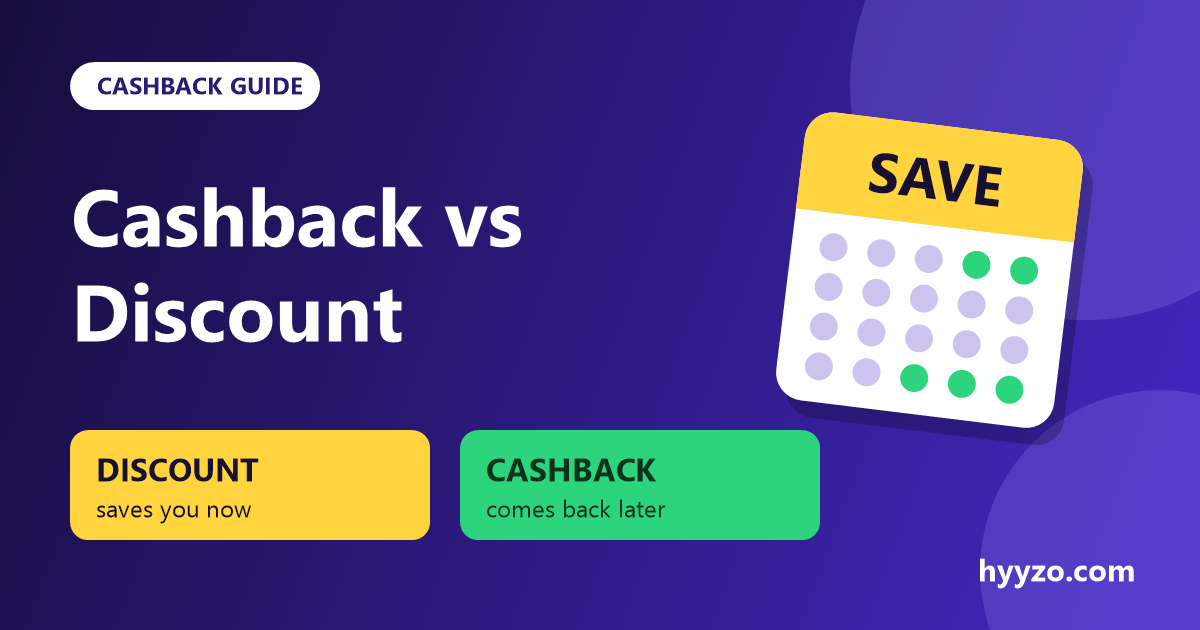
A discount lowers the price you pay now. Cashback gives some money back after you buy. If both are worth the same, take the discount, because you keep the money at once. Cashback wins when the amount you will really receive is bigger, or when you can add it on top of a discount.
Last updated: 28 November 2026. All prices and percentages below are examples to show the maths, not live offers.
Cashback and discount: the difference at a glance
| Point | Discount | Cashback |
|---|---|---|
| When you benefit | At checkout | Later, after the offer's conditions are met |
| Amount you pay today | Lower | Often the full price shown |
| Waiting | None | Can take days or weeks |
| Chance of not getting it | Low once it shows on your bill | Possible if a rule is missed |
| If you return the item | You are refunded what you paid | The cashback is usually cancelled |
| Where the money goes | It stays with you | Bank, card statement, wallet or store credit |
What is a discount?
A discount is a cut in price before you pay. You may see it as a lower sale price, a percentage off, a bank offer applied at checkout or a code you enter. For codes in particular, see our comparison of cashback and coupons.
What is cashback?
Cashback is a part of your spending returned to you after the purchase. It can come from a cashback website, a bank or card, or the seller. How you can use it depends on who gives it. Our guide to what cashback is explains the basics.
Four examples on a Rs 2,000 purchase
1. Same percentage
| Offer | You pay today | You get later | Final cost |
|---|---|---|---|
| 10% discount | Rs 1,800 | Rs 0 | Rs 1,800 |
| 10% cashback | Rs 2,000 | Rs 200 | Rs 1,800 |
The final cost is equal, so the discount is better. You pay less today and take no risk of waiting.
2. Bigger cashback
| Offer | You pay today | You get later | Final cost |
|---|---|---|---|
| 5% discount | Rs 1,900 | Rs 0 | Rs 1,900 |
| 12% cashback | Rs 2,000 | Rs 240 | Rs 1,760 |
Cashback saves Rs 140 more, if you meet the rules and can wait for the money.
3. Capped cashback
| Offer | You pay today | You get later | Final cost |
|---|---|---|---|
| 10% discount | Rs 1,800 | Rs 0 | Rs 1,800 |
| 20% cashback, maximum Rs 150 | Rs 2,000 | Rs 150 | Rs 1,850 |
The headline says 20%, but the cap limits it to Rs 150. The smaller looking discount is better.
4. Discount and cashback together
| Step | Amount |
|---|---|
| Price | Rs 2,000 |
| Less 20% discount | Rs 400 |
| You pay | Rs 1,600 |
| 5% cashback on Rs 1,600 | Rs 80 |
| Final cost | Rs 1,520 |
Here you benefit twice. Notice that cashback is worked out on Rs 1,600, not on the original Rs 2,000. This is common, but terms differ.
Instant discount vs cashback on card offers
Payment offers often come in these two forms. An instant discount reduces the bill before you pay. A cashback offer charges you the full amount and returns money later, often on your card statement or in a wallet. Check the minimum spend and the maximum amount for either one, and check when the money arrives.
Which should you choose?
| Your situation | Usually better |
|---|---|
| Both offers are worth the same | Discount |
| You do not want to wait or track anything | Discount |
| The cashback you will receive is clearly higher | Cashback |
| Cashback can be added to a discount | Both |
| Cashback can only be spent in one store you rarely use | Discount |
A quick way to compare any two offers
Final cost = price, minus the discount, minus the cashback you will really receive, plus any fees. Work it out for each offer and pick the lower number.
- Start with the same item and seller. A bigger offer on a higher price can still cost more.
- Count only usable cashback. If it is store credit you will not use, treat it as zero.
- Apply the cap. Use the smaller of the percentage amount and the maximum.
- Add delivery and other fees. They can wipe out a small saving.
- Check the date. Ask yourself if you can wait for the cashback.
For example, an item at Rs 950 with free delivery beats the same item at Rs 900 with a Rs 99 delivery fee, because the second one costs Rs 999.
Check these before you decide
- Cap: the most you can receive.
- Minimum spend: do not buy extra items only to qualify.
- Where it is paid: bank money is more flexible than store credit.
- Waiting time: see how pending cashback is confirmed.
- Eligible items: some categories earn less or nothing.
- Returns: returned or cancelled orders normally lose their cashback.
Can you get both?
Often you can. Start with the sale price, add an eligible payment offer and use cashback where the terms allow it. A coupon or browser add-on from another website can stop cashback from tracking. To see the rules for a shop, open its page from all stores on Hyyzo. For the full method, read our cashback stacking guide.
Cashback and discount FAQs
What is the difference between cashback and discount?
A discount reduces the price you pay at checkout. Cashback is money returned to you after you buy, often after the order is confirmed.
Is cashback the same as a discount?
No. Both can lower your final cost, but a discount does it immediately, while cashback arrives later and can depend on conditions.
Which is better, cashback or discount?
If both are worth the same amount, a discount is better because you get it at once. Cashback is better when its confirmed value is higher or when you get it on top of a discount.
Can I get both cashback and a discount?
Often yes. A store price cut can combine with cashback if the terms allow it. Some coupons can stop cashback, so read the rules first.
What is the difference between instant discount and cashback?
An instant discount is taken off your bill before you pay. Cashback is paid back later, to a bank account, card statement or wallet, depending on the offer.
Is cashback calculated on the original price?
Not always. It is often worked out on the amount you pay for eligible items, without fees. Check the offer terms.